
NPPF Changes 2026: What Do the Latest Planning Reforms Mean for Residential Projects?
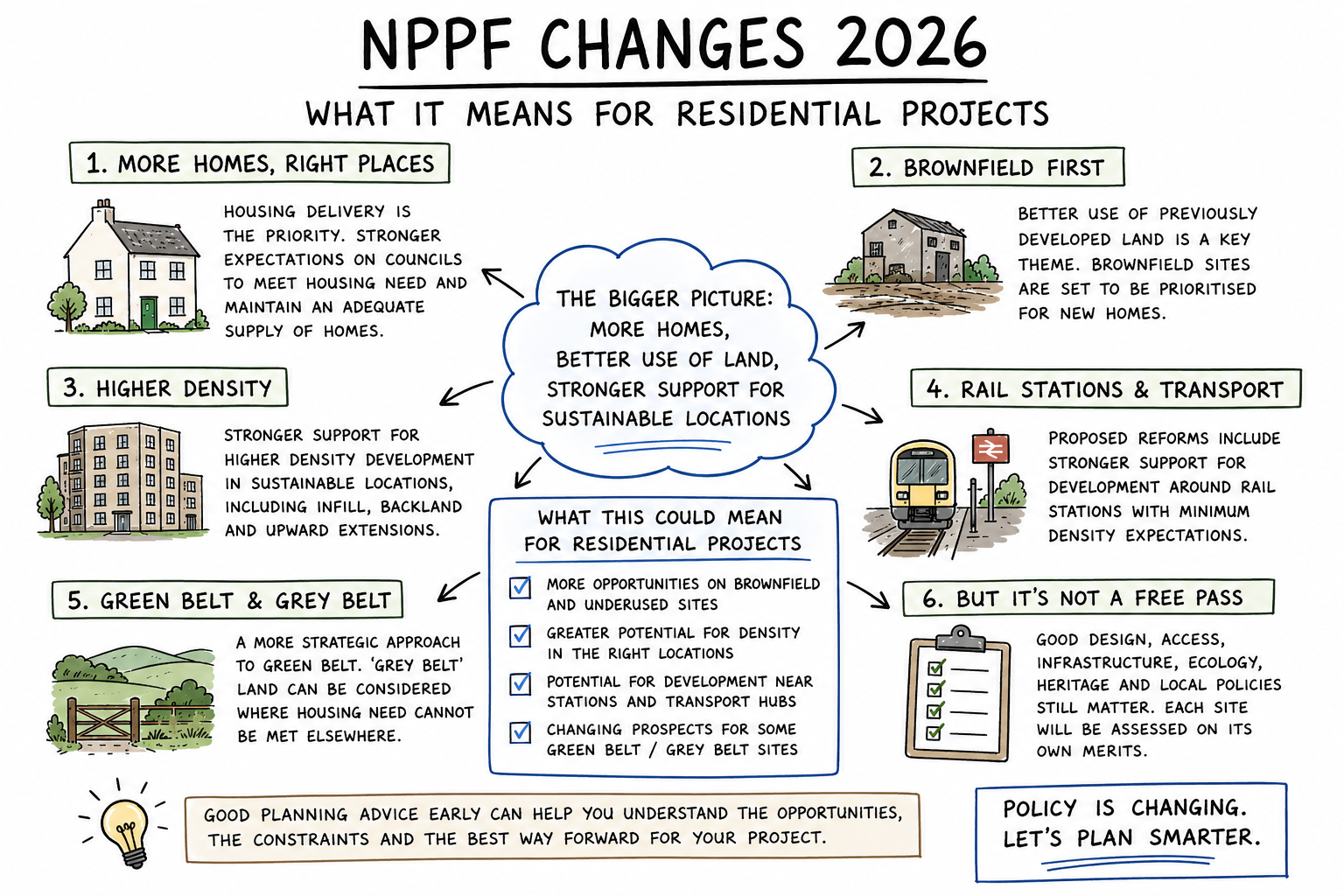
NPPF Amendments 2026 - Diagram
The planning system in England is going through one of its biggest periods of change in years.
For homeowners, developers and anyone considering a residential project, the National Planning Policy Framework (NPPF) is becoming increasingly important. Changes to national planning policy can influence how local planning authorities assess planning applications, how much weight is given to housing delivery and where new homes are expected to be built.
The latest proposals could have a particularly significant impact on residential development, from individual new-build homes and infill schemes to larger housing sites and developments around transport hubs.
But what do the NPPF changes actually mean if you're planning a residential project?
And perhaps more importantly, could the changes make it easier to obtain planning permission?
What is the NPPF?
The National Planning Policy Framework is the Government's national planning policy for England.
It sets out the principles and policies that planning authorities are expected to follow when preparing local plans and making decisions on planning applications.
It doesn't replace your local planning policies. Instead, national policy sits alongside the development plan and provides an important framework for how planning decisions should be made.
This means that changes to the NPPF can have a direct impact on residential planning applications, even where the proposal itself is relatively small.
The Government's December 2024 revision introduced significant changes, including stronger housing delivery requirements, a renewed focus on brownfield land and a new approach to Green Belt and "grey belt" land.
Further major reforms were then proposed in December 2025, with the consultation updated in February 2026. These proposals aim to create a more rules-based planning system and further increase the supply of housing.
So, what does all of this mean for residential projects?
A Stronger Focus on Building More Homes
At the heart of the NPPF reforms is a straightforward objective:
Build more homes in the right places.
The Government has set an ambition to deliver 1.5 million homes over the Parliament, with national planning policy being used as one of the mechanisms for increasing housing delivery.
The December 2024 NPPF strengthened the expectation on local authorities to plan for housing need, including through mandatory housing targets.
This matters because local planning authorities aren't simply considering individual applications in isolation. They are also expected to maintain an adequate supply of housing land and have up-to-date planning policies capable of meeting identified needs.
For residential developers, that can be significant.
Where a council is struggling to demonstrate an adequate housing supply, national policy can become an increasingly important part of the planning balance.
However, this doesn't mean that every residential application automatically becomes acceptable.
Location, design, access, infrastructure, environmental considerations and local planning policies still matter.
Brownfield Development Is Being Prioritised
One of the clearest themes running through the recent planning reforms is the Government's brownfield-first approach.
Brownfield land generally refers to land that has previously been developed.
The Government wants planning authorities to make better use of previously developed land, particularly within existing urban areas, before looking towards undeveloped land elsewhere.
The December 2024 NPPF strengthened this approach, while the proposed 2026 reforms go further by seeking stronger support for suitable development on urban brownfield land.
For residential developers, this could create opportunities on sites that may previously have faced a more difficult planning journey.
Examples could include:
Previously developed residential land.
Redundant commercial sites.
Underused urban land.
Former employment sites where residential development is appropriate.
Large residential gardens in suitable circumstances.
Infill opportunities within existing settlements.
Redevelopment of low-density sites.
The important point is that brownfield does not automatically mean planning permission will be granted.
A brownfield site still needs to be suitable for the proposed development, and matters such as access, design, flood risk, ecology, heritage and neighbouring amenity will continue to be relevant.
Nevertheless, the policy direction is increasingly clear: making better use of existing developed land is a major part of the Government's strategy for delivering new homes.
Could Higher Density Development Become Easier?
Another important part of the proposed reforms is the push towards higher-density development in sustainable locations.
The Government is proposing stronger support for urban and suburban densification, including opportunities such as infill development, redevelopment of low-density sites and upward extensions.
This could be particularly relevant for residential developers looking at:
Backland development
Infill plots
Corner plots
Subdividing larger sites
Replacing existing buildings
Additional homes within existing settlements
Upward extensions and redevelopment
The principle is relatively simple: where land is already well connected to services and infrastructure, there may be opportunities to accommodate more homes without continually expanding settlements outwards.
For smaller developers, this could make previously overlooked sites worth investigating.
However, density alone won't make a development acceptable.
A scheme still needs to demonstrate that it provides a suitable form of development for its location. Poor-quality or overdevelopment proposals aren't suddenly given permission simply because a site is brownfield or within an urban area.
Development Around Railway Stations
One of the more interesting proposals in the 2026 NPPF consultation is the introduction of stronger support for residential development around railway stations.
The Government is proposing in-principle support for suitable development around rail stations, including certain locations outside existing settlements and potentially on Green Belt land.
The proposals also include minimum density expectations around stations.
The suggested figures are:
40 dwellings per hectare around stations.
50 dwellings per hectare around "well-connected" stations.
The intention is to make better use of locations where residents already have good access to public transport, jobs and services.
For developers, this could make land close to railway stations increasingly attractive.
A site that might previously have been considered too constrained for residential development could potentially become more viable if national policy provides stronger support for higher-density development in that location.
That said, these are proposed changes, rather than something developers should currently assume applies automatically to every station site.
What About Green Belt and Grey Belt Land?
Green Belt policy has perhaps received the most attention from the recent NPPF changes.
The December 2024 NPPF introduced the concept of "grey belt" land and created a more strategic approach to considering Green Belt land for development.
The intention isn't to simply open up the Green Belt for unrestricted development.
Instead, the policy identifies circumstances where certain land within the Green Belt may be suitable for release or development, particularly where housing need cannot otherwise be met.
The Government has also introduced so-called "Golden Rules" for certain Green Belt development, including requirements relating to affordable housing, infrastructure and the provision of green space.
For residential developers, this means Green Belt land should no longer be viewed simply as:
"Green Belt = impossible."
Equally, it would be a mistake to interpret the reforms as:
"Green Belt = automatic planning permission."
The planning circumstances of the individual site remain critical.
What Does This Mean for Small Residential Developments?
It's easy to read about national housing targets, grey belt land and major development sites and assume the NPPF only matters to large developers.
It doesn't.
The national policy framework can also be relevant to smaller residential schemes.
For example, you may be considering:
A new house on an infill plot.
Subdivision of a large residential garden.
Replacing an existing building with housing.
Converting or redeveloping an existing site.
Building several homes on an underused parcel of land.
Increasing the number of homes on an existing site.
The proposed direction towards making better use of urban land could create opportunities for smaller sites, particularly where they are well located and capable of accommodating additional homes without causing unacceptable impacts.
The December 2024 Framework already encourages planning authorities to support small and medium-sized sites and windfall development, while the proposed reforms seek to go further on urban densification.
Does the NPPF Mean Planning Applications Will Be Easier to Get?
This is where it's important to be realistic.
The NPPF changes are designed to support housing delivery, but they don't remove the need for a good planning case.
A residential development still needs to be properly designed and appropriately located.
Planning authorities will continue to consider issues such as:
Highway safety and access.
Flood risk.
Ecology and biodiversity.
Heritage.
Landscape impact.
Residential amenity.
Privacy and overlooking.
Design and character.
Infrastructure.
Local planning policies.
Site-specific constraints.
The NPPF can strengthen the policy case for residential development, but it doesn't override every other planning consideration.
A poorly designed development on an unsuitable site isn't necessarily rescued by the Government's housing ambitions.
The Importance of Housing Land Supply
One area where national policy can become particularly important is housing land supply.
Planning authorities are expected to maintain an appropriate supply of housing land. The NPPF sets out requirements around the identification of deliverable and developable sites, including the five-year housing land supply framework.
If a council cannot demonstrate the required supply, the planning balance can change.
This is particularly relevant for residential applications because the delivery of new homes can carry significant weight in the planning decision-making process.
However, housing land supply is a technical subject and shouldn't be reduced to a simple formula of:
"The council doesn't have five years of housing, therefore my application will be approved."
The circumstances of each application still need to be considered.
What Should Residential Developers Do Differently?
The changing policy environment makes early planning advice increasingly valuable.
If you're looking at a potential residential development site, don't simply ask:
"Can I get planning permission here?"
Instead, look at the bigger picture.
1. Assess the site's location
Is the site within an existing settlement?
Is it close to shops, schools and services?
Is there good public transport?
Is it close to a railway station?
These factors can become increasingly important as national policy places greater emphasis on sustainable locations and making efficient use of land.
2. Understand the site's planning history
Previous applications, refusals and approvals can provide valuable information about how the site has been assessed.
A previous refusal doesn't necessarily mean the site can never be developed.
Equally, an old planning permission doesn't necessarily mean a new proposal will be acceptable.
3. Investigate brownfield and grey belt opportunities
If you're assessing a site that is previously developed or potentially within the grey belt, it's worth understanding how the latest national policy could affect its prospects.
This is an area where professional planning advice can be particularly useful.
4. Consider density early
Don't automatically assume that the number of homes currently proposed is the maximum potential.
Equally, don't assume that higher density is automatically better.
The right density needs to respond to the site's context, surrounding development and infrastructure.
5. Look beyond the headline policy
National policy is only one part of the planning system.
The local plan, neighbourhood plan, supplementary planning documents and site-specific constraints can all influence the outcome.
A successful development strategy brings these different layers of policy together.
What About Home Extensions?
For homeowners considering a typical rear or side extension, the NPPF changes are unlikely to suddenly transform the basic Permitted Development rules.
This is an important distinction.
Permitted Development Rights are primarily governed by the Town and Country Planning (General Permitted Development) Order, rather than the NPPF.
So if you're planning a standard house extension, the first question remains whether the proposal meets the relevant Permitted Development requirements.
If it doesn't, and a planning application is required, the NPPF can then become relevant as part of the wider planning policy context.
In other words:
NPPF reform does not mean you can automatically build a larger extension without planning permission.
But where a planning application is necessary, national policy may form part of the assessment alongside the local development plan and other material considerations.
The Bigger Picture: More Homes, Better Use of Land
The direction of travel is clear.
The Government wants England's planning system to deliver more homes, make better use of previously developed land, increase density in suitable locations and unlock development opportunities in areas where housing need is greatest.
The December 2024 NPPF has already changed the planning landscape, particularly through stronger housing targets, brownfield policy and the new approach to Green Belt and grey belt land.
The proposed 2026 reforms could take this further by creating stronger support for suitable urban development, higher-density schemes and development around well-connected transport locations.
For residential developers, that means opportunity—but not certainty.
A site that may previously have been dismissed at first glance could now deserve a much closer look.
What Does This Mean for Your Residential Project?
If you're considering developing a site, adding new homes, subdividing land or increasing the density of an existing residential site, the changing NPPF could be relevant to your plans.
But national policy needs to be considered alongside the specific circumstances of your site.
At the earliest stage, we recommend establishing:
What the current planning policy says.
What changes are proposed.
How the local planning authority is performing against its housing requirements.
Whether the site is brownfield or potentially grey belt.
What local planning policies apply.
What constraints could affect development.
What scale and density of development may be realistic.
Whether a pre-application submission would be worthwhile.
The planning system is changing quickly, and understanding the policy position before you invest heavily in design work can make a significant difference to the viability of a residential project.
Planning a Residential Development?
Whether you're considering a single new dwelling, garden development, infill scheme, redevelopment opportunity or a larger residential project, our team can assess the planning position and help you understand what may be achievable.
Don't rely on an old planning assumption.
With national planning policy changing, now is the time to review the potential of your site and understand how the latest reforms could affect your project.
Get in touch with our team to discuss your residential development and find out what planning options may be available.