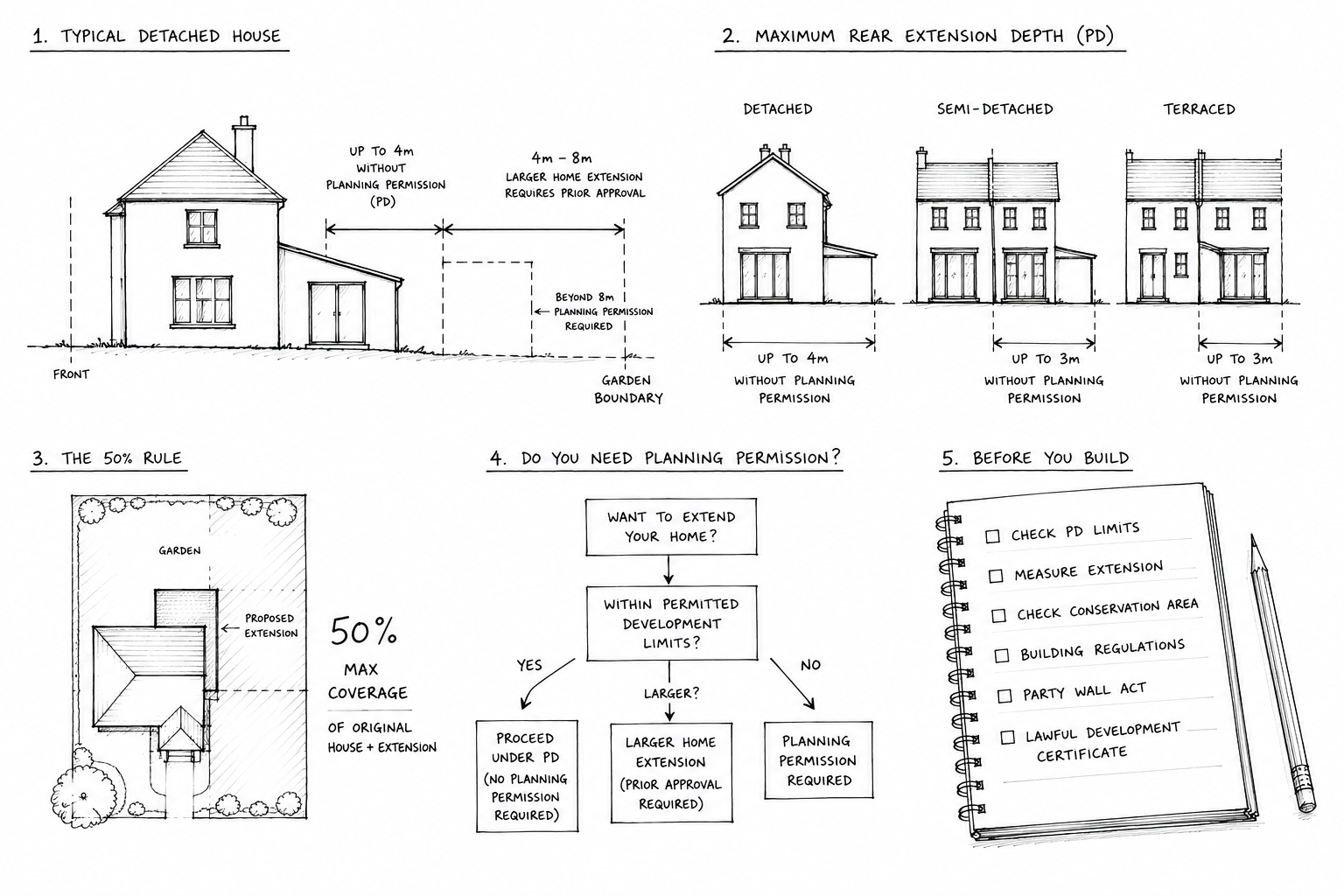
How Far Can You Extend Your Home Without Planning Permission
Now that you understand how Permitted Development works, the next question is usually the one every homeowner wants answered:
‘How big can my extension actually be?’
The answer depends on several factors, including the type of property you own, the number of storeys you’re planning to build and whether your home has already been extended in the past.
While Permitted Development offers generous allowances, there isn’t a single size that applies to every property.
Single-Storey Rear Extensions
For most homeowners, a single-storey rear extension provides enough additional space to create an open-plan kitchen, dining area or family room.
Under current Permitted Development rules, you can normally build:
Up to 3 meters beyond the original rear wall on a terraced or semi-detached house
Up to 4 meters beyond the original rear wall on a detached house
These measurements are taken from the original rear wall of the property, not from any extension that may already exist.
It’s almost important to remember that these are maximum limits. Your proposed extension must still comply with other restrictions relating to height, boundaries and the amount of garden that remains.
Larger Rear Extensions
If you are hoping to build beyond the standard limits, you may still have options.
In certain circumstances, homeowners can construct significantly deeper single-storey rear extensions by following the Larger Home Extension process.
Subject to eligibility and the neighbour consultation procedure, this may allow:
Up to 6 meters for semi-detached and terraced houses
Up to 8 meters for detached houses
Although this route avoids a full planning application, it does involve additional procedures before construction can begin, so professional advice is often worthwhile.
Two-Storey Rear Extensions
Adding a second storey creates a valuable extra accommodation, particularly for growing families. However, the planning rules become considerably stricter.
Under Permitted Development, two-storey rear extensions are generally limited to:
A maximum projection of 3 meters beyond the original rear wall.
Additional conditions also apply, including restrictions on height, roof design, boundary distances and the placement of upper-floor windows. These are intended to reduce the impact on neighbouring properties and maintain privacy.
Size Isn’t the Only Limitation.
Many homeowners focus entirely on the depth of their proposed extension, but this is only one part of the planning assessment.
An extension may satisfy the depth limits but still fail to qualify under Permitted Development because of another restriction.
For example, your proposal must also comply with rules relating to:
Overall height
Eaves height near neighbouring boundaries
The percentage of your garden that remains undeveloped
Materials used on the external walls
Roof design
Balconies, raised platforms and verandas
This is why it’s essential to consider the regulations as a whole rather than treating the maximum depth as the only requirement.
Every Extension Starts with the Original House
One detail that often surprises homeowners is that Permitted Development rights are measured from the original dwelling, not necessarily the house you see today.
If previous owners have already built an extension, that work may count towards the property’s overall allowance. In other words, you cannot simply add another four meters because the existing extension has already used part of the available limits.
Understanding where the original house begins is one of the most important parts of assessing whether your proposal qualifies.
In the next section, we’ll explore the situations where Permitted Development doesn’t apply at all, including conservation areas, converted properties, flats and homes where development rights have been removed.