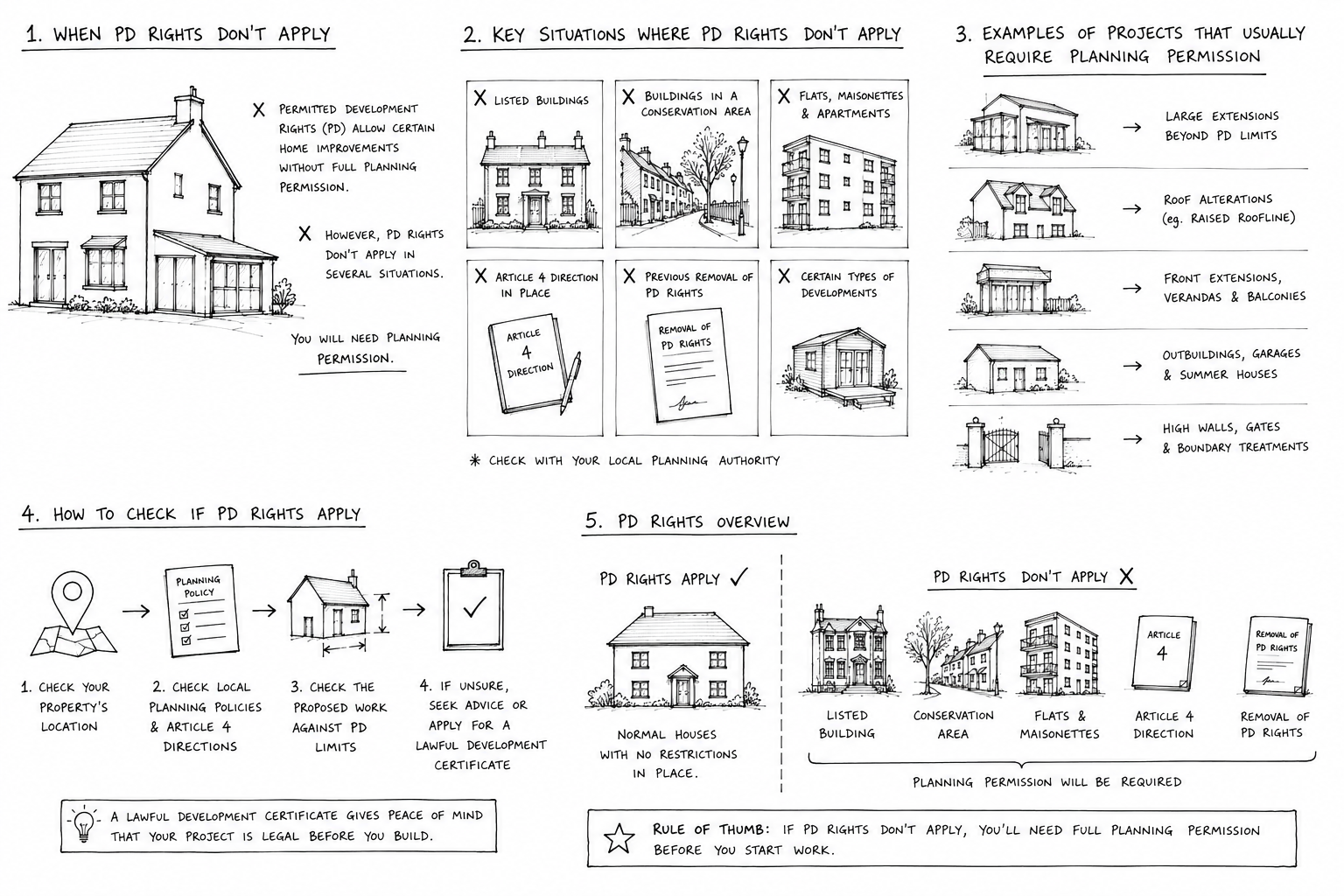
When Permitted Development Rights Don’t Apply
Although Permitted Development Rights make it possible for many homeowners to extend their property without planning permission, they don’t apply to every home. In some cases, these rights have never existed, while in others they may have been removed by the local planning authority.
Understanding whether your property still benefits from Permitted Development should be one of the first checks you make before spending money on drawings or construction.
Flats and Maisonettes
Permitted Development Rights for rear extensions are intended for houses, not flats or maisonettes.
If you own a flat, whether it’s on the ground floor or within a converted building, you’ll normally need to apply for planning permission before carrying out an extension. This is because flats are subject to different planning legislation, with greater consideration given to the impact on neighbouring residents and the wider building.
Homes in Protected Areas
If your property is located within a designated area, additional planning controls are likely to apply.
These areas include:
Conservation Areas
National Landscapes (formerly Areas of Outstanding Natural Beauty)
National Parks
The Broads
World Heritage Sites
Living in one of these locations doesn’t automatically prevent you from building an extension. However, the scope of Permitted Development is often more limited, particularly for larger two-storey extensions.
The aim is to preserve the character, appearance and historic significance of these protected environments.
Article 4 Directions
Some local councils introduce what's known as an Article 4 Direction.
This removes certain Permitted Development Rights in specific areas where the council believes greater planning control is necessary.
Article 4 Directions are commonly used in historic town centres, conservation areas and locations with distinctive architectural character. If your property falls within one of these areas, work that would normally be permitted elsewhere may require a full planning application.
Your local planning authority can confirm whether an Article 4 Direction affects your property.
Planning Conditions Can Remove Your Rights
Even if your home is outside a protected area, Permitted Development Rights may still have been removed through a planning condition.
This is particularly common on:
New-build housing developments.
Individual plots granted planning permission with specific restrictions.
Homes where previous planning approvals included conditions limiting future alterations.
Many homeowners assume that because they own a house, they automatically benefit from Permitted Development. Unfortunately, that's not always the case.
A simple planning history check can often reveal whether any restrictions are in place before costly mistakes are made.
Converted Properties
The planning history of your property can also influence what you're allowed to build.
Some homes that have been converted from commercial, agricultural or industrial buildings have different planning rights from traditional houses. Depending on how and when the conversion took place, Permitted Development Rights may be restricted or removed entirely.
If you're unsure about your property's history, it's worth obtaining professional advice before progressing with your extension plans.
Previous Extensions Still Matter
Another factor that's frequently overlooked is previous development.
Permitted Development allowances are assessed against the original house, not necessarily the property as it stands today.
If earlier owners have already added extensions, conservatories or other additions, these may count towards the amount of development already carried out. As a result, your remaining allowance could be significantly less than expected—or even exhausted altogether.
This is one of the most common reasons homeowners discover that a project they believed was permitted actually requires planning permission.
When in Doubt, Check Before You Build
Planning legislation can appear straightforward at first glance, but every property has its own planning history. Two houses on the same road can be subject to completely different restrictions depending on when they were built, previous planning decisions and whether any conditions have been imposed over the years.
Taking the time to confirm your property's planning status before work begins can save thousands of pounds in redesign costs, avoid enforcement issues and give you confidence that your extension complies with current regulations.
In the next section, we'll look at another area that regularly causes confusion—how existing extensions, Victorian outriggers and wraparound designs are treated under Permitted Development.